




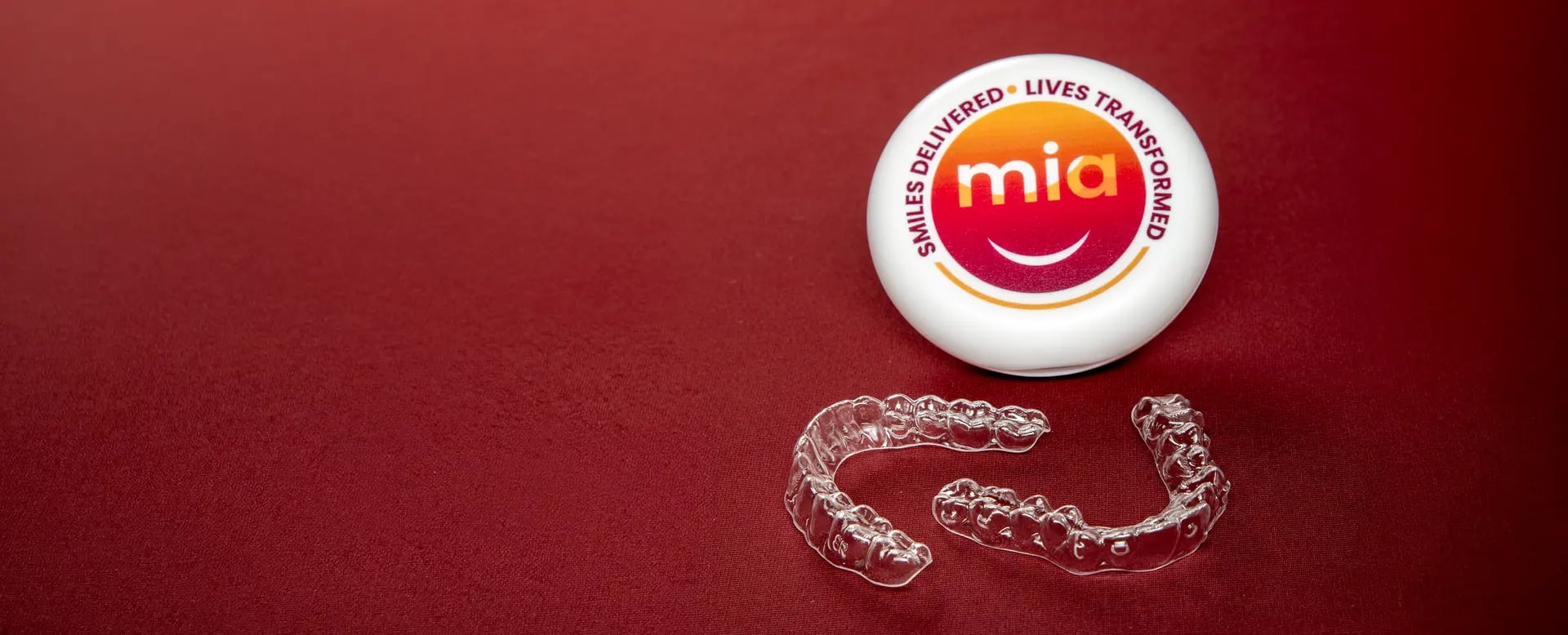
Our aligners are thermoformed from iZi Flex Tri-Layer PRO, a true-extruded sheet where three engineered polymers are bonded into a single structure. Not laminated. Not glued. That’s why force delivery stays consistent over the wear cycle, and the aligner doesn’t delaminate, peel or craze in the mouth.
True-extruded as one solid structure
Stable performance over the wear cycle
Reduced initial pressure, predictable movement
Resists cracking, staining and daily fatigue
High-clarity, stain- and crack-resistant copolyester engineered for shape memory. The layer your patients see, and the layer that keeps the aligner tracking on the planned arch form.
Buccal skin · clarity · trackingThe mechanical heart of the sheet. Medical-grade thermoplastic polyurethane delivers controlled, sustained force with reduced initial pressure, better comfort, less force-decay, more predictable tooth movement between visits.
Mechanical heart · sustained forceMirrors the buccal layer for symmetric force delivery. Resists deformation, cracking and fatigue under normal wear, including engagement over attachments and IPR sites.
Lingual skin · symmetric forceFour properties that matter when the aligner is in the mouth for two weeks at a time.
Co-extruded structure, no adhesive boundary to fail
Stable force retention vs. mono-layer PETG over 14-day wear cycle.
Optical-grade copolyester outer skins for patient acceptance
Every sheet thermoformed within 15 minutes of opening.
Mia’s attachment library is a controlled set of geometries inside our treatment-planning protocol, each one modelled and force-vector tested against a specific movement. We don’t decorate teeth. We use the smallest, smartest attachment that achieves the planned movement, and we remove it from staging the moment it’s done its job.
Workhorse attachment for vertical control. Broad flat surface delivers a clean force vector for vertical movements of bicuspids and incisors.
Engages cervically to deliver torque and uprighting moments. Used for canine rotations, posterior tip-back and premolar uprighting.
Low-profile ellipsoid for controlled anchorage and retention. Default for posterior anchorage in retraction cases.
Bevel-led attachment engineered for the bio-mechanics of extruding lower anteriors. Concentrates force occlusally without unintended rotational vectors.
Every attachment shape, position and stage in a Mia plan is reviewed by our clinical team before any aligners are produced, and justified against the planned movement. Less is more.
The world’s leading orthodontic AI engine, running our team’s clinical playbook. SoftSmile Vision handles the heavy computational work, tooth segmentation, root estimation, collision modelling, movement-vector simulation. The decisions that matter clinically, staging logic, velocity caps, attachment placement, finishing rules, come from Mia’s own treatment protocols, written by working clinicians and refined across 20,000+ cases.
A world-class planning engine that turns intra-oral scans into segmented, simulatable arches in minutes. What the AI delivers:
Built by working clinicians, the spine of every plan, applied on top of the AI:
The AI does the computational work; the Mia protocols decide the clinical answer. Every plan is then reviewed by an HPCSA-registered clinician on our team before it ships to a provider. You will never approve a setup built purely by an algorithm.
Same five stages on every case, first or fiftieth. The provider sees the plan, requests changes, and approves it. No plan ships without that loop closing.
IOS scan upload (or impression-to-scan conversion). Scan-quality check runs immediately.
Tooth segmentation, root estimation, collision modelling, movement-vector simulation in minutes.
Velocity caps, attachment rules, finishing logic applied on top of the AI output.
Every plan reviewed and signed off by a working clinician before it reaches the provider.
The plan is shared with annotated views and notes. Provider approves, requests revisions, or escalates.
A founding member of Mia and instrumental in bringing this product to market. The treatment-planning protocols, refinement policies and case-selection logic Petra built across thousands of South African cases still sit behind every Mia plan today, and were the training data the AI orthodontic tools we use have been shaped against. The technology is the leverage; her clinical playbook is the answer.
Materials, mechanical, manufacturing and clinical specs, for the clinician who wants the full picture before committing a patient to a treatment plan.
Every aligner is produced under a controlled SOP, eight defined operator roles and a traceable batch record on every patient. Industrial-grade 3D printing, calibrated thermoforming, final QC. A 0.1 mm error at the model doesn’t stay 0.1 mm in the mouth.
Approved plan exported from SoftSmile Vision with stage naming, attachments, IPR notes and blockouts locked.
Industrial 4K LCD printing in Rigid DL240 Plant-Based resin, ±0.10% volumetric accuracy across the full build envelope.
Photocentric Air Wash and Cure L2 post-cure, full mechanical properties before any sheet touches the model.
BIOSTAR thermoforming with material-coded heat profiles. Tri-Layer PRO sheets thermoformed within 15 min of opening.
In-process and final inspection, no aligner is packed without a QC pass and a batch record.
On LC Magna validation prints, across the full build envelope.
Scanned dental-model points within ±0.10 mm of CAD.
Biobased fraction in our Rigid DL240 dental-model resin.
Distinct roles in the production SOP, each gated by a documented QC pass.
Mia is one of very few clear-aligner systems in the world that is locally designed, locally produced, and built on plant-based, recyclable manufacturing inputs. Two values that compound, pride in keeping the work here, responsibility for the country we work in.
Company, design, planning and production all happen in South Africa. Local employment, local supply chain, local clinical IP.
Our Rigid DL240 dental-model resin is 50% biobased, lower embedded carbon than conventional petrochemical resins, without sacrificing clinical accuracy.
Cured models, sheet offcuts and packaging routed to recovery streams. Closed-loop where the polymer permits, downcycled where it doesn't.
Aligners aren't shipped across two oceans. Local manufacturing cuts international freight emissions and removes FX shipping costs baked into every imported case.
Every Mia aligner case is planned and approved by an HPCSA-registered clinician on our team. The system is designed by the people who use it, and the people who’ll plan your case are the people you call when something needs a second opinion chairside.

Mia co-founder, still running Mia Aligner cases in her own practice today. Drives the clinical standard with a passion for South Africa, aesthetic dentistry and serving her patients with the best possible treatments.

The latest addition to our team, stepping in as leading orthodontist after one of our founding members: Dr Petra van der Merwe, moved to Namibia. Brings a wealth of experience in both fixed and aligner treatments.

The doyen of South African ortho-lab products. Developed the country’s first aligner system with Dr Mark Bowes over 15 years ago, that depth of knowledge, case history and market-leading orthodontic-treatment integrations now sits behind every Mia case.

Worked alongside Dr Petra for years on all her cases and became deeply specialised in the planning software, all the tricks and AI protocols that bring your smiles to life. Creative yet responsible, with the judgement to add real value to your practice.

Treatment planner out of the Adam Labs team. Day-to-day output, scan-to-plan workflow, attachment placement, staging, and the back-and-forth on plan revisions until it’s right.

The person who keeps your account moving, onboarding, case status, refinement requests, peer-event invites and support escalation. The single point of contact when you need something done.
What clinicians want to know before they commit a patient, materials, AI, certifications, the clinical safety net. If yours isn’t here, WhatsApp us and we’ll route you to the right person.
Both are thermoplastic copolyesters in the PET family, but PCTG (PET-G with cyclohexanedimethanol) has improved clarity, better impact strength, and superior crack resistance compared with standard PETG. In the Tri-Layer PRO sheet, PCTG forms the buccal and lingual skins because those are the layers patients see and the layers that have to resist daily fatigue. The mechanical heart of the sheet is the Lubrizol TPU core, not the outer layers: PCTG’s job is clarity and shape memory while the TPU delivers controlled force.
Mono-layer PETG aligners suffer from significant force decay over the 14-day wear cycle, force drops sharply in the first 24 to 48 hours and continues to decay through the wear period. Medical-grade thermoplastic polyurethane delivers sustained force with a much lower decay curve, which means more predictable tooth movement between visits and reduced initial pressure for the patient. Thicker PETG doesn’t solve the decay problem, it just makes the aligner harder to insert and more visible.
No. SoftSmile Vision handles the computational layer, segmentation, root estimation, collision modelling, vector simulation. The clinical decisions, staging logic, velocity caps, attachment placement, refinement triggers, finishing rules, come from Mia’s treatment protocols, written by Dr Petra van der Merwe and refined across thousands of SA cases. Every plan is then reviewed and signed off by an HPCSA-registered clinician on our team before it ships. You never approve a setup built purely by an algorithm.
All polymers in the iZi Flex Tri-Layer PRO sheet are FDA-cleared for intra-oral medical use and have been ISO 10993 biocompatibility tested. No latex, no BPA, no phthalate plasticisers. The Rigid DL240 plant-based dental-model resin complies with EU and US dental-printing standards for orthodontic-model production. Mia’s manufacturing operation aligns with SAHPRA requirements for a medical-device production facility, with HPCSA-registered clinical leadership over every case.
SoftSmile Vision is a world-class orthodontic planning platform that has been trained on a large clinical case base globally. What makes it Mia-specific is the protocols we run on top of it. Mia’s staging logic, velocity caps, attachment library and refinement triggers are encoded as the layer above the AI, effectively, our clinical playbook is the post-processing layer that turns a generic AI output into a Mia plan. Dr Petra van der Merwe’s protocols are the spine of every plan, and the AI is the leverage that lets us apply that playbook to your patient in minutes rather than hours.
On clinical output, Mia is at parity with the market leader on the dimensions that affect outcomes, 99 µm print precision, the same biocompatible material classes, every plan reviewed by an HPCSA-registered clinician. Mia’s refinement rate sits at 23% versus the 50% international industry average, partly because of the tri-layer sheet, partly because of the Mia protocols layered on the AI. Where Mia genuinely differs is in the relationship: direct WhatsApp to the planning clinician, 5 to 7 day plan-to-delivery from Cape Town, no quotas, and a partner that can’t pull out of South Africa because Cape Town is the only home we have.
30 minutes. Honest conversation. We walk through the product detail, talk about your case mix, and decide together if Mia is the right fit. No pitch deck. No pressure.